Investing
As Good As It Gets: JPMorgan's Record Quarter, CPI Cools, TSMC's $100B Bet
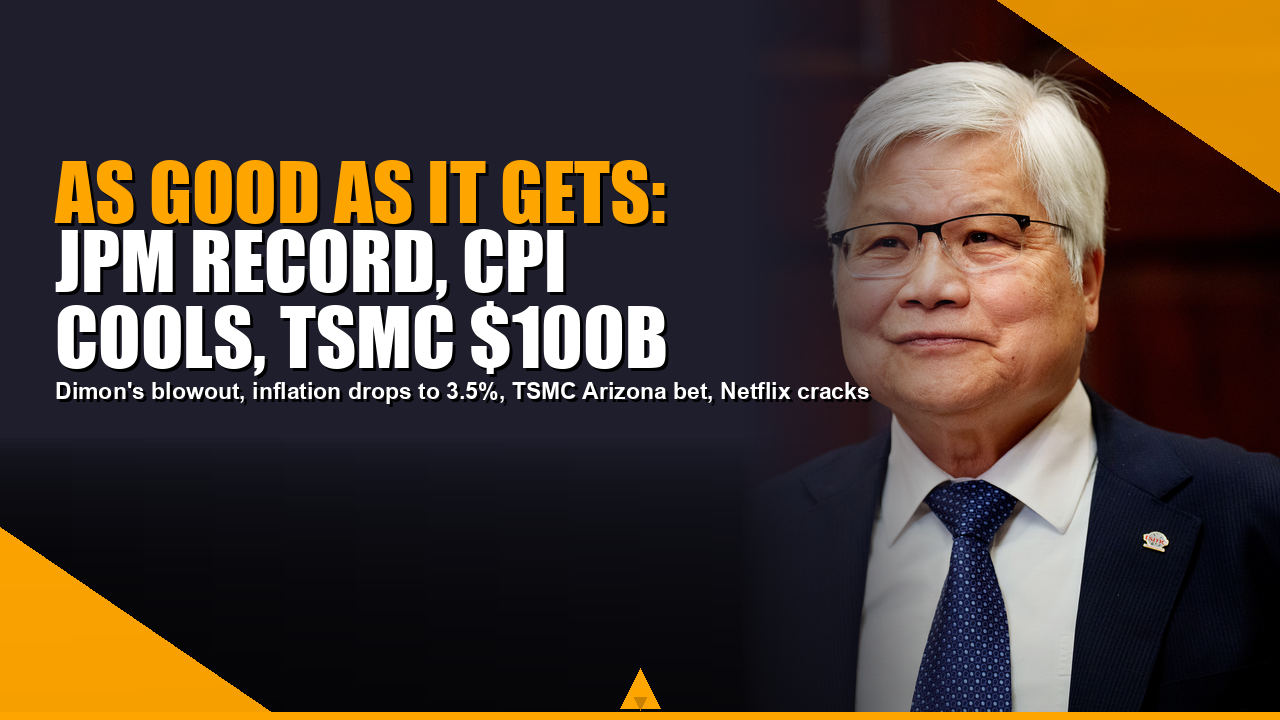
"The economy is close to as good as it gets." That was Jamie Dimon on Tuesday morning, one day after announcing that JPMorgan Chase had just posted the largest quarterly profit in its 226-year history. Net income of $21.2 billion, EPS of $7.70, revenue of $57.3 billion — all records, all crushing consensus. Then on Wednesday came the June CPI print showing headline inflation cooled to 3.5% annually, a bigger drop than anyone expected. And on Thursday, TSMC delivered a 77% profit jump and announced a $100 billion Arizona expansion.
Read together, this week gave the bulls almost everything they wanted. The consumer is intact. Investment banking is on fire. Trading is euphoric. AI capex is not slowing. Inflation is cooling on its own. This is the fundamental case for the "goldilocks-plus-inflation" thesis in cleaner data than we have seen in two years. Netflix disappointed, retail sales came in soft, and the geopolitical picture remains dangerous — but the core narrative of the week was overwhelmingly positive. Here is what happened and how retail investors should read it.
JPMorgan's Record Quarter Was Historic
JPMorgan reported Tuesday before the open and the numbers were staggering. Net income of $21.2 billion was up 41% year over year and represents the largest quarterly profit any US bank has ever reported. Adjusted EPS of $6.14 (excluding a $4.6 billion one-time gain on the Visa stake) beat consensus of $5.59 by nearly 10%. Revenue of $57.3 billion beat by more than $7 billion.
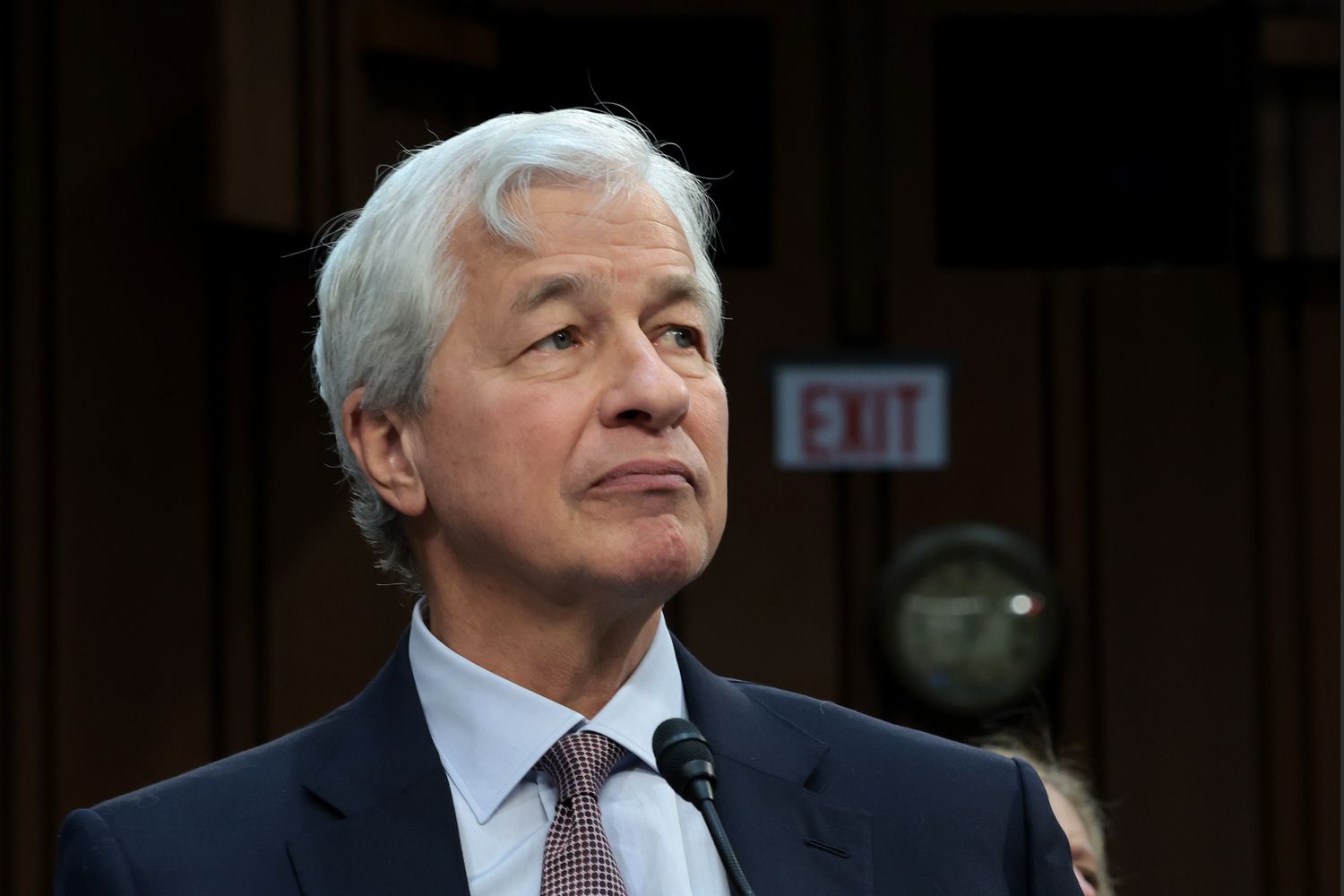
The composition mattered as much as the headline. Investment banking fees rose 30% year over year to $3.9 billion. Equities trading revenue exploded 86% to $6 billion — the largest quarter for JPMorgan's equities desk in history — driven by the volatility triggered by the war in Iran and the SpaceX IPO. Fixed-income trading was more muted at +6%. Consumer and Community Banking revenue rose 8% to $20.3 billion. Asset and Wealth Management revenue rose 19% with $5.1 trillion under management.
But the single most important number was hidden four pages into the release: the credit-card net charge-off rate. It fell from 3.47% in Q1 to 3.34% in Q2, and JPM guided to approximately 3.2% for the full year. This is the exact opposite signal PepsiCo flagged the week before. If consumer credit is not deteriorating at JPMorgan's card book — which is the largest and most-representative in the US — then the "consumer is cracking" narrative from lower-income snack demand looks like a small, staples-specific issue rather than a broad economic warning.
June CPI Cooled More Than Expected
Wednesday morning brought the second-most-important print of the week. June CPI fell 0.4% month-over-month and the annual rate dropped to 3.5%, meaningfully below consensus. Gasoline prices led the decline. Core CPI ticked up but by less than feared, and shelter inflation continued the gradual moderation that has defined 2026 so far.
This print resets the Fed calculus significantly. Recall from last week's post — the June FOMC minutes showed a genuinely split committee, with the hawkish camp arguing that stubborn inflation and a firming labor market justified potential rate hikes. Cool CPI removes the fuel from that argument. Fed funds futures now price roughly a 15% chance of a September hike, down from about 50% before the CPI release. The market is now leaning toward a hold through year-end, with the possibility of a cut re-entering the conversation if unemployment ticks higher or CPI prints another sub-3.5% number in July.
The two-year Treasury yield fell 12 basis points on Wednesday, the biggest single-day drop since March. The 10-year fell 8 basis points. The dollar weakened. Small caps outperformed the S&P by more than a percentage point on the day. This is what a "goldilocks resolution" looks like when the market sees inflation cooling and Fed hikes coming off the table.
TSMC's $100 Billion Arizona Bet
Thursday morning brought the third pillar of the bullish week. TSMC reported Q2 revenue of $40.2 billion (at the high end of guidance, up nearly 40% YoY), and Q2 net income jumped 77% year-over-year to a record. High-Performance Computing — the segment that includes AI chips and data-center GPUs — grew 20% quarter-over-quarter and now represents more than 60% of total revenue. Gross margins hit a record 58.6%.

The bigger story was the announcement that came alongside the earnings: TSMC will invest an additional $100 billion in its Arizona semiconductor manufacturing footprint over the next four years. This is the largest single foreign investment in US manufacturing in history, and it comes on top of the $65 billion Arizona commitment TSMC had already made. It is a direct read on the durability of AI capex — companies do not commit $165 billion in fabs unless they believe demand for advanced-node chips will persist for a decade or more.
For Nvidia, AMD, and Broadcom shareholders, this is validating. TSMC is signalling that HBM3E and HBM4 memory-bound compute demand — the shape of chips Nvidia's Blackwell architecture needs — will continue to soak up TSMC's entire advanced-node capacity through at least 2029. For Micron, this reinforces the Q1 earnings blowout from Run 14. For Apple, which is TSMC's largest customer, the read is more nuanced — Apple gets first pick of leading-edge nodes, but competition for that capacity from Nvidia and Amazon is intensifying.
Netflix Cracked The Bull Narrative Slightly
Not every earnings print was a beat. Netflix reported Thursday after the close and delivered a mixed quarter that spooked investors. Revenue of $12.56 billion narrowly missed consensus of $12.58 billion — a 20-basis-point miss but still up 13.4% year over year. EPS of $0.80 beat consensus of $0.79 by a penny. Operating margin came in at 33.4%, down from 34.1% a year earlier.

The stock fell 8.6% in after-hours trading. The core reason: Q3 guidance implied a further deceleration to about 11.7% revenue growth, and management confirmed that content spending is now shifting later in the year, pressuring near-term margins. Consumers noticed the recent price increases. The ad-tier tailwind is starting to plateau. Netflix is the first name to show a clear "peak growth" signal in this earnings cycle, and it matters because Netflix has been one of the best-performing FAANG-era names since early 2024.
For retail investors, the read-through is important. Netflix is not signaling that streaming is broken — subscription trends, retention, and pricing power are still healthy. But it is signalling that the easy-comparisons era for high-growth mega-caps is ending. The multiple compression happens fastest for names where investors were paying for growth. Watch this carefully into Alphabet, Meta, Amazon, and Microsoft prints over the next two weeks.
Retail Sales Came In Softer
The one clear negative of the week beyond Netflix was June retail sales. The headline print of +0.2% missed consensus of +0.4% and continued the deceleration that started in April. Excluding autos and gas, the print was +0.3%. The consumer is not collapsing — the CNBC/NRF Retail Monitor showed the ninth straight month of sales growth on their preferred measure — but the pace is slowing. Prime Day and other promotional events pulled some spending forward into June, which will hurt July prints.
The pattern in the data now clearly shows a divided consumer. Higher-income households are still spending on services, travel, and premium experiences. Middle- and lower-income households are pulling back on discretionary goods and snack food (see PepsiCo last week) while continuing to spend on essentials. This split-consumer story is why retail sales at the headline level look modest while service-industry ISM readings and airline revenue remain elevated. Wednesday's cool CPI print helps by leaving real wages positive for a fourth straight month.
Five Lessons From This Week
1. Consumer credit is intact. JPMorgan's card charge-off rate fell to 3.34% and guided to 3.2%. The lower-income softening at PepsiCo does not translate to broad credit deterioration. This is the single most important data point for the second-half consumer thesis.
2. Investment banking is having its best year since 2021. JPMorgan IB fees +30% and equities trading +86% will translate across the Q2 bank universe. If you own bank ETFs (XLF, KBE, KRE), the setup for the next two quarters looks strong.
3. AI capex is not slowing. TSMC's $100 billion Arizona announcement plus the +77% profit growth and record HPC segment margins confirms that Nvidia's data-center revenue is not a short-term bubble.
4. Fed hike odds collapsed. September hike probability fell from ~50% to ~15% on the CPI cool print. The hawkish FOMC minutes narrative from last week just lost its data support. Watch the July FOMC decision on July 30 for the confirmation.
5. High-growth multiples are compressing. Netflix's 8.6% after-hours drop on a mixed print is a warning that the "buy the growth" era is transitioning to "buy the earnings power." Rotation into value, small caps, and cyclicals continues to make sense.
Week Ahead
Next week is the heart of Q2 earnings season. Monday brings Domino's, Verizon, RTX. Tuesday is huge — GM, Coca-Cola, Lockheed Martin, Halliburton, Chipotle, Texas Instruments before the open, then Alphabet and Tesla after the close. Wednesday delivers Boeing, AT&T, IBM, ServiceNow. Thursday is Union Pacific, American Airlines, Blackstone. Friday closes with Colgate-Palmolive and preliminary Q2 GDP.
Alphabet and Tesla on Tuesday are the single most important prints for AI capex and EV demand respectively. Alphabet's cloud growth rate and capex guidance will confirm or complicate the TSMC read-through. Tesla's Q2 deliveries were already announced at 480K (see Run 15), so the earnings call focus will be on gross margin, energy storage growth, and the FSD/Robotaxi capital timeline.
The other setup worth flagging is the July 30 FOMC decision. With CPI cooling and JPMorgan's data confirming a healthy consumer, the odds of any hike this year have effectively collapsed. Markets are now positioning for an unchanged decision with dovish forward-guidance shifts. If the SEP shows a slight downward revision to the 2026 PCE dot from 3.6% back toward 3.3-3.4%, expect a strong reaction in the two-year yield and small caps.
The discipline for retail investors is unchanged from last week. Let the data do the work over the next three weeks. Q2 earnings are running strong. Inflation is cooling. Consumer credit is healthy. AI capex is durable. The bear case has narrowed to "geopolitics + valuation" — real concerns, but not fundamental economic ones. This is a good market to add on weakness in earnings-driven names that maintain guidance, and to trim expensive high-growth names that are decelerating.
If you want live commentary on Alphabet and Tesla Tuesday night, the FOMC decision, and daily briefings as they happen, join our Telegram community: https://t.me/+6VRTM83FVqEwZDll
Together, Next Level.