Investing
The Abel Era Begins: Berkshire's New Playbook in a Week of AI Earnings
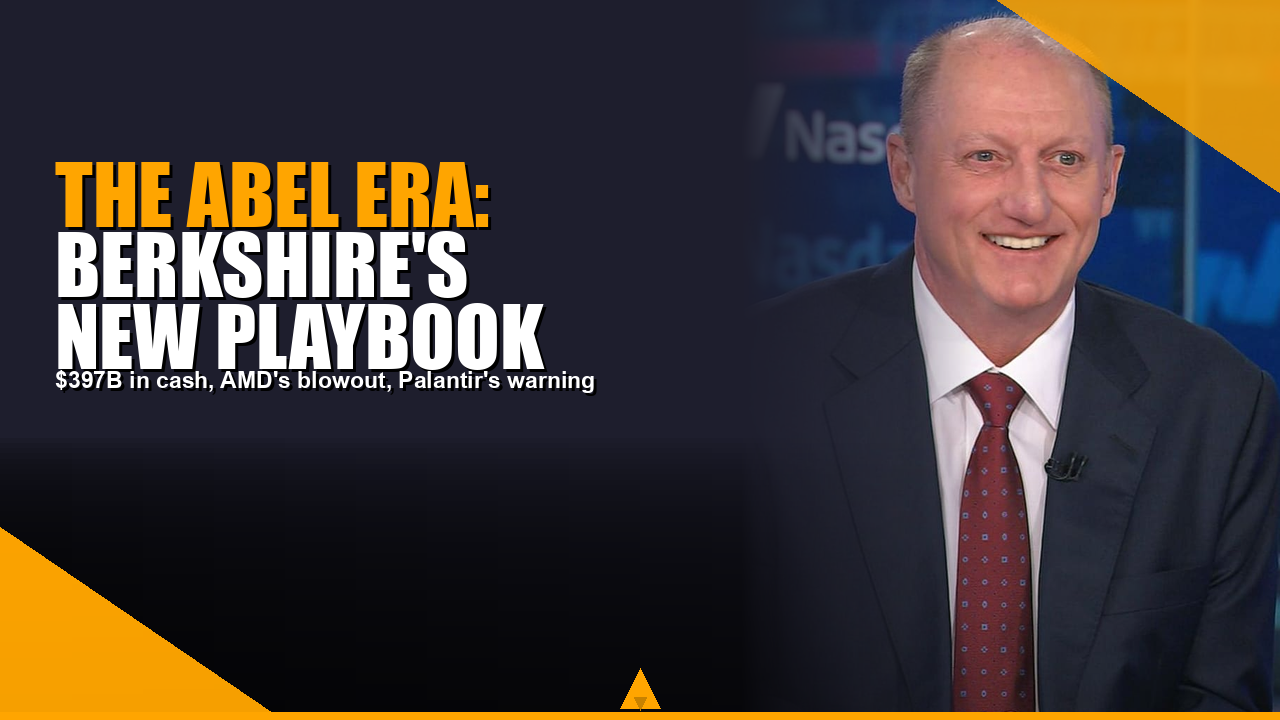
For the first time in 60 years, Warren Buffett did not chair the Berkshire Hathaway annual meeting. On Saturday, May 3, in Omaha, a Canadian-born former utilities executive named Greg Abel took the stage in front of 30,000 shareholders and ran the show himself.
It was a quiet, almost orderly handover. No fireworks. No grand announcements. But behind that calm was a $397 billion cash pile, a renewed buyback, and a company that just earned more in one quarter than most S&P 500 names earn in a year. Meanwhile, the broader market was busy digesting blowout AI earnings from Palantir and AMD, a softer-than-feared jobs report, and Disney's surprise streaming profit jump.
This is the week the post-Buffett era officially began, and the week the AI trade quietly proved it still has fuel. Here is what retail investors should take away.

The Abel Era Begins, Quietly
Abel's first message to shareholders was deliberate: nothing changes that does not need to. He ruled out breaking up the conglomerate, said the operating businesses will keep running with the same long leashes, and emphasized that Berkshire's job is to be patient, disciplined, and ready when others are not.
The numbers backed him up. Q1 2026 operating profit climbed 18% year-over-year, with insurance underwriting up more than 28%. Revenue came in at $93.7 billion, net income at $10.1 billion, and cash and short-term Treasuries hit a record $397 billion as of March 31. Berkshire was a net seller of stocks again, with roughly $24 billion in sales versus $16 billion in purchases.
The buyback story is the most interesting wrinkle. After almost two years of inactivity, Berkshire bought back $234 million of its own stock in March, and Abel himself purchased shares personally. That is a tiny number against a $1 trillion-plus market cap, but the symbolism matters. Abel is signaling that capital will move when value shows up, not on a schedule.
For investors, the takeaway is simple: this is still the same playbook. If anything, it is a more conservative version of it.
Palantir's Beat That Didn't Excite Anyone
On Monday after the close, Palantir reported what should have been a victory lap. Q1 revenue jumped 85% year-over-year to $1.63 billion, beating estimates handily. Management raised full-year 2026 guidance to $7.65 to $7.66 billion, well above the $7.27 billion consensus. U.S. commercial and government segments both grew at triple-digit rates.

The stock fell almost 7%.
Why? Because closed-contract value, the metric that tells you what is locked in for future quarters, decelerated from 138% growth to 61%. At a stock trading north of 200 times forward earnings, deceleration of any kind is a problem. Investors are not punishing Palantir for performing badly. They are punishing it for performing slightly less spectacularly than the price required.
This is the lesson behind the lesson: when valuations are extreme, beats are not enough. The bar is "beat and accelerate." If a company merely beats and grows fast, the multiple compresses. Retail investors holding high-multiple AI names need to internalize this before the next earnings season, not after.
AMD Quietly Stole the Week
If Palantir was the cautionary tale, AMD was the mirror image. On Tuesday, AMD reported Q1 revenue of $10.25 billion (+38% YoY), beating the $9.84 billion estimate. Data center revenue alone was $5.8 billion, up 57% year-over-year, and crucially it grew sequentially in a quarter that is normally seasonally weak. Non-GAAP EPS came in at $1.37 versus $1.29 expected.
The bigger surprise was guidance. AMD guided Q2 revenue to $11.2 billion at the midpoint, implying 46% YoY growth and another sequential acceleration. The stock jumped about 18%.

The number that mattered most was buried inside the data center line. Sequential growth in Q1 broke a multi-year seasonal pattern in semiconductors. That tells you Meta's previously announced 6 gigawatt MI450 deployment is real, EPYC server CPUs are pulling more share, and AMD is no longer just a speculation on next year's chips. It is generating real revenue today, on top of a credible roadmap to MI400 on TSMC's N2 process in 2027.
For retail investors who have only ever owned Nvidia in the AI trade, this is a moment to widen the lens. The picks-and-shovels theme has more than one supplier now.
Disney's Streaming Surprise
Wednesday morning, Disney reported fiscal Q2 with revenue of $25.17 billion and adjusted EPS of $1.57, both ahead of expectations. The headline, though, was streaming. Operating income from the direct-to-consumer business jumped 88% to $582 million. Management lifted the buyback authorization to $8 billion.
Streaming was Disney's wound for years. Now it is profitable enough to justify a real buyback. The market took notice.
The broader read for investors: legacy media companies that survived the cord-cutting decade and managed to scale streaming without burning cash are now compounding earnings again. They no longer need to be "story stocks." They have proper margins. That changes the conversation around names like Disney, Netflix, and Warner Bros Discovery for anyone building a long-only portfolio.
The Jobs Report and the Soft Landing
Friday morning at 8:30 a.m. Eastern, the April employment report landed. Going in, the Bloomberg consensus was for 65,000 jobs added with the unemployment rate steady at 4.3%. Wells Fargo had pencilled in around 70,000 with the unemployment rate ticking up to 4.4% on higher participation. Either outcome would be a major slowdown from March's 178,000 print.

The setup is what matters. JOLTS data earlier in the week showed job openings holding steady at 6.9 million, with hiring jumping by 655,000. That is the kind of mix that lets the Fed sit on its hands. Rates were left at 3.50 to 3.75% at the April 28-29 meeting with four dissents, the most since 1992. Markets are now pricing in essentially no cuts before September.
For investors, the message is consistent: the economy is cooling, but not breaking. That is exactly the environment in which quality compounders, dividend payers, and cash-rich balance sheets tend to outperform. It is not a time for max leverage on the most speculative end of the market.
Five Lessons From the Week
Pulling these threads together, here is what I want every Next Level student to take away from this week:
1. A great handover is boring on purpose. Abel's first meeting was deliberately uneventful. That was the point. Berkshire's edge is process, not personality. When you study great companies, look for ones that work without their founder.
2. Cash is a position, not a problem. $397 billion in cash earning short-term yields is not laziness. It is option value. The day Abel finds the right opportunity, that pile becomes the most powerful capital in the market.
3. At extreme valuations, beats are mandatory and not enough. Palantir grew 85% and still fell 7%. Always ask: what is already priced in?
4. Diversify within the AI trade. AMD's quarter changes the picks-and-shovels narrative. Owning only Nvidia is now a more concentrated bet than it looks.
5. Cooling is not crashing. Soft hiring plus stable openings plus 4.3% unemployment is a goldilocks environment, not a recession. Position accordingly.
Week Ahead
Next week brings the April CPI report on Tuesday, retail sales on Thursday, and continued earnings from Walmart, Cisco, and Applied Materials. Warsh Senate confirmation hearings for the Fed Chair role are also expected to begin. The S&P 500 closed Wednesday at 7,200, just below its all-time high. With sentiment elevated and positioning still long, the next CPI print becomes the swing factor for the next leg.
For Next Level students, the playbook does not change. Stay diversified across themes. Trim positions where the multiple has run ahead of the fundamentals. Keep a cash buffer big enough to act when others have to sell. And read management transcripts, not just headlines. The Berkshire meeting transcript alone is a free MBA in capital allocation.
If you want to discuss this week's moves with other investors, learn the frameworks we use to read earnings, and get our weekly portfolio walkthrough, join us on Telegram: https://t.me/+6VRTM83FVqEwZDll
Together, Next Level.